


Ask the Experts24/7 Online Support
Ask the Experts24/7 Online Support
India |
December 30, 2025 | 11:37 AM
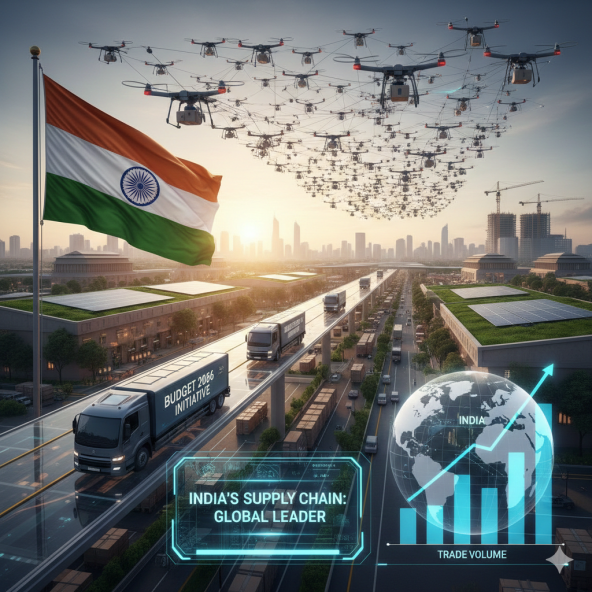
New Delhi, 30 December 2025 — As India prepares for the Union Budget 2026, policymakers are focusing squarely on strengthening the country’s supply chain ecosystem to reduce import dependencies, improve competitiveness, and narrow the growing trade gap with major suppliers like China. The budget is being viewed as a pivotal opportunity to transform India’s supply chain from a reactive system reliant on imports into a strategically resilient manufacturing and logistics platform.
In recent years, India’s merchandise trade deficit has widened, reflecting faster growth in imports compared to exports. Critical sectors such as machinery, electronics, chemicals and capital goods continue to be dominated by imports, particularly from China, posing challenges for domestic industries and exporters. Despite having capable manufacturing sectors, India struggles with pricing, quality and scale in global markets — problems rooted in structural supply chain weaknesses.
The upcoming budget is expected to introduce a multi-pronged strategy aimed at revitalising India’s supply chain through fiscal incentives, calibrated tariffs, and targeted support for strategic sectors.
One of the most significant proposals under consideration is a “100-product reset”. This initiative aims to identify about 100 goods — including engineering products, machinery and select consumer items — for tariff rationalisation and support measures that will encourage domestic production over imports.
Customs duties on many such products currently sit at moderate levels that have not discouraged import dependence. Policymakers believe that adjusting tariffs, coupled with incentives, can help reduce reliance on external suppliers while protecting nascent local capacities.
Beyond tariffs, the budget discussions are emphasising the importance of structural upgrades across the supply chain:
Reducing Logistics Costs: India’s internal logistics costs — significantly higher than peers — act as a “silent competitiveness tax.” Lowering these costs is seen as essential to improving export competitiveness and enabling Indian products to compete effectively in global markets.
Support for MSMEs: Micro, small and medium enterprises are acknowledged as the backbone of India’s supply chain but face acute challenges such as limited credit access, compliance burdens, and vulnerability to tariff shocks. Industry representatives have called for policy support that includes easier access to finance, export support mechanisms, and schemes to help these enterprises scale up.
Strengthening Critical Minerals and Inputs: India has considerable reserves of critical minerals like rare earth elements, which are vital for high-tech manufacturing. The budget is expected to prioritise production, processing, and strategic utilisation of these minerals to support sectors such as electronics, clean energy, and advanced materials.
Semiconductors and Electronics: While India has made significant progress in electronics manufacturing, semiconductors remain a strategic gap. Government plans approved in recent years signal growing domestic investment in chip ecosystem development. Expanding semiconductor manufacturing capacity through public-private collaboration is expected to remain a key policy priority.
India’s supply chain challenge is not limited to tariffs alone. A resilient and competitive system requires:
Improved manufacturing scale and quality
Enhanced access to credit and financial safety nets for SMEs
Reduced compliance and administrative friction
Strategic collaboration in sectors with high import dependence
Reducing reliance on any single geography — particularly China — remains an overarching goal. India’s trade with China continues to show persistent imbalances, highlighting the need for diversified sourcing and stronger domestic capabilities.
India’s logistics ecosystem — encompassing transportation, warehousing, and freight connectivity — plays a pivotal role in determining the overall competitiveness of Indian goods. High logistics costs increase the price of domestic products, eroding competitiveness internationally. Government infrastructure investments aimed at improving connectivity, reducing congestion, and streamlining freight movement are expected to be central components of the supply chain strategy.
Union Budget 2026 represents a critical juncture for India’s ambition to upgrade its supply chain architecture. By combining targeted tariffs, incentives, logistics reforms, MSME support and strategic industrial policy, the government aims to position India as a competitive force in global manufacturing.
The choices made in this budget will shape India’s trade and industrial landscape for years to come — determining whether the nation can narrow its trade imbalances, reduce import dependencies, and build supply chains that are resilient, diversified and globally competitive.
Comments (0)
No record(s) Found !